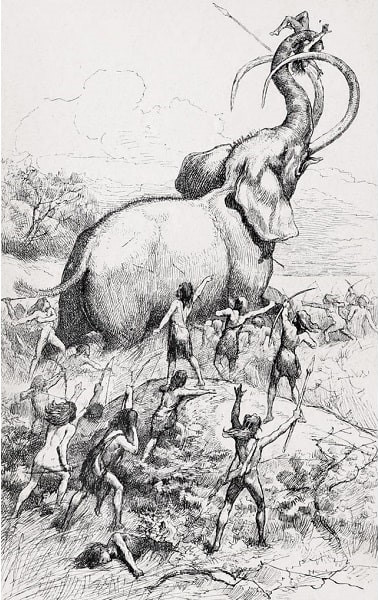
“Last night, everyone huddled close to the campfire’s ring of light. Grandfather told stories of mighty hunters; all were wise and brave. He is our clan’s Maker. Points of stone for the hunters’ spears and arrows are made only by his hands. These pointed stones kill, more deadly than just throwing rocks. Our points are a gift from the Ancestors. Makers are revered as a clan’s life source; stone points feed us and protect us from animals and invaders.”
Behind the Pages
Imagine you’re hiking through the prairie grasslands of Southern Colorado. Pausing to rest on a small boulder, you notice it wobbles under you. Looking down, you see an odd depression half-covered by this rock. The dirt is hard and dry when you kick it with your boot. You get down and begin to dig with your pocketknife, curious about this strange indentation in the land.
First, you come to a cluster of buried rocks, untouched and purposefully arranged, not there randomly by nature. You pry them out of the dirt, one by one. Excitement consumes you. You wonder if they conceal buried gold forgotten centuries ago by Spanish conquistadors or silver nuggets left by a wayward pioneer or miner.
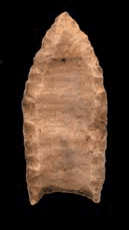
The secret buried in the dirt sees sunlight after centuries of darkness. You lift out dozens of sharp pointed rocks never created by just nature. They are finely made, graceful and lethal. You’ve stumbled on a cache of paleolithic weaponry left behind by Paleoindian people . . . made over 11,000 years ago after the last ice age.
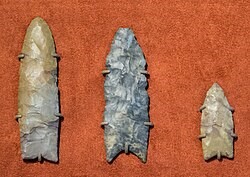
Questions flood into your mind. Who once held these fluted projectile points? Who made them? Why are they buried here?
Your surprise discovery comes from the Clovis culture, a period of early inhabitants during13,400 – 10,800 BCE.
A typical Clovis point is a medium to large lance point with sharp edges, a third of an inch thick, one to two inches wide, and about four to five inches long. Sides show careful pressure flaking along the blade edge. The broadest area is towards the base which is distinctly concave with concave grooves called “flutes” removed from one or, more commonly, both surfaces of the blade. The lower edges of the blade and base are ground to dull edges for attachment to a spear.
From reading military novels, you know flutes and channels in a piercing weapon cause blood to flow more openly from a wound. You are holding an ancient tool meant to kill.
Generations before you were born, ancestral indigenous people in North America were making distinctive fluted projectile points easily recognized because of their large size, their exquisite craftsmanship, and the beautiful stones which master toolmakers chose for them. The Clovis point in your hand is shiny black and mysterious.
Chipped from obsidian, this lance-shaped tip and wickedly sharp edges extend from the base toward the tip in shallow, concave grooves. It is about four inches long and a third of an inch thick. It’s easy for you to admire its aerodynamic shape, so sleek and beautiful.
From genetic analysis and extensive archaeological findings, Clovis people were the ancestors of modern Native Americans, possessing genetic markers akin to Asian populations. One migration possibility suggests that fluted spear point makers moved northwest from Siberia following bison through an emerging ice-free corridor and into the Yukon and
Alaska, spreading their technology into new territories.
Holding this ancient artifact, you close your eyes and imagine the hunter who was to use this weapon. Athletic. Sturdy. Clad in furs.
What highly nomadic clan was this weapons cache intended for? They weren’t farmers like their Pueblo descendants, but hunter-gatherers, moving frequently across the landscape between camps and caves. Were these points left for a disrupted hunt of Pleistocene megafauna? Had a mammoth herd been tracked for the clan’s need for food before the coming winter?
It seems to you that people who crafted such an innovative weapon must have had others: advanced tools like blades, scrapers, knives, drills, needles, and bone tools. Now more curious, you want to Google this back home.
Dislodging more points from the cache hole, you see varied sizes, different stones: jasper, quartzite, chalcedony, chert, more obsidian, and other fine, brittle stones. One point is nine inches long. Could it be specialized? Used to pierce a mammoth hide? From a PBS Nova documentary, you recall archeological digs where masses of mammoth bones were mixed in with slender, finger-long spear points in large numbers.
How hard are these to make? You wonder if only a special clan member was trusted for this duty. Remembering a summer camp as a child, memories arise of a morning spent making arrow heads from stone. Frustrated by the tricky process, it was easy to break or shatter the rock by delivering a forceful blow when it was almost finished. If not held correctly and the striking platform was not positioned precisely, the resulting chip was too shallow or heavy-handed. You remembered holding two halves of an arrowhead or another one shattered into nothing. You decide the clan’s point maker would have been revered and depended on by the clan for survival. Yet, you decide it would better to be a hunter in that primitive time, not the master point maker. The responsibility must have been high and unforgiving.
Back in 7th grade History class, a guest archeologist gave a talk about an “atl-atl.” At the time, you thought how cool it would be; to use this simple yet clever notched throwing stick to toss your dog’s ball further. Judging by the lethal stone tools now arrayed in front of you, the atl-atl wasn’t a toy. It was survival of puny humans against an enormous, terrified, and dangerous mammoth. The atl-atl projecting spears meant food and life for the clan.
You admit chasing after giant beasts with only sticks and sharp, pointed stones is dangerous. How could any group base its subsistence on something so risky? You question your own bravery if suddenly time-warped to a Paleolithic time. A root canal or one hundred pushups seems minor to a death-risking mammoth hunt.
When wandering from camp to cave to camp, a system of stocked and hidden caches of Clovis points would be the sensible answer to better clan mobility. The wide variety of stones in your newly found cache suggest the Clovis culture traveled great distances to obtain high-quality, indicating a significant value in these weapons. And when one is following mega-animal herds for one’s dinner, it is necessary to roam far and wide.
Thinking about your survivalist friends, it makes sense your imaginary hunter and his clan maintained a diet focusing on big-game hunting, particularly mammoths, along with mastodons, elk, bison, dire wolves, saber-toothed tigers, giant sloths, and camels. But they also consumed smaller animals like turtles, fish, and gathered wild greens, berries, and tubers. An omnivore diet dependent on nature’s generosity made the difference between surviving and not.
Yet, recent isotope studies confirm they relied heavily on mammoth meat. You chuckle to yourself and realize even a vigorous day hike on just one weekend day needs more protein, less carrots. Paleolithic wanderers needed marathon energy every day.
Despite your admiration for the technological wonder you’ve unearthed, it looks quaint considering your contemporary sensibilities. Reaching for the first Clovis point you pulled from this ancient cache, the lives of hunter-gatherers seem lacking and below the superiority you give yourself as a modern human – Advanced. Accomplished. Smarter.
Daring to touch the tip of the point, a tiny drop of blood appears on your finger. You are not so advanced as to respect early humanity. Not so accomplished as to make one of these weapons yourself. And not so smart as to obey common sense: “points are sharp.”

.jpg)